





The XIV School of Physics Roberto A. Salmeron (EFRAS-14) will take place from September 8 to 12, 2025, at the International Center for Physics of the University of Brasília, with the theme: "Modern Topics in Mathematical Physics". The school will consist of mini-courses, plenary lectures, student oral presentations, and poster sessions.
-
 Destaques
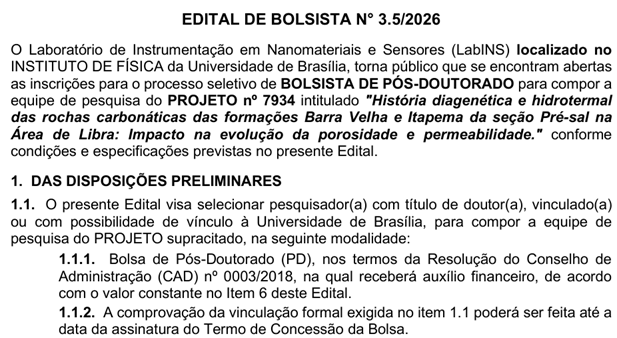
Divulgação Edital de Bolsista Nº3.5/2026
EDITAL DE BOLSISTA N° 3.5/2026 O Laboratório de Instrumentação em Nanomateriais e Sensores (LabINS) localizado no INSTITUTO DE FÍSICA da Universidade de Brasília, torna público que se encontram abertas as inscrições para o processo seletivo de BOLSISTA DE PÓS-DOUTORADO para compor a equipe de pesquisa do PROJETO nº 7934 intitulado "História diagenética e hidrotermal das rochas carbonáticas das formações Barra Velha e Itapema da seção Pré-sal na Área de Libra: Impacto na evolução da porosidade e permeabilidade." conforme condições e especificações previstas no presente Edital. Edital completo em PDF
-
 Destaques
Clipes das palestras do CIF
Esta página contém pequenos trechos de palestras proferidas no CIF (de até 1 minuto) sobre assuntos mais interessantes da ciência! Cortes sugeridos pelo estudante do Instituto de Física da UnB: Gustavo Pinto da Silva Linhares Bezerra Tecnologias Quânticas Criptografia Pós-Quânticahttps://youtube.com/clip/Ugkx96Q9HhW8YbLtV_6_yhxPH271CgQFbDMr?si=7L5eWU8KEygreHpC slot gacor Física Nuclear e de Partículas Cromodinâmica Quântica: o que é carga de cor?https://youtube.com/clip/UgkxlrKeRjnYJi69IkdVHNgXKowyZoP-f5Zl?si=NznRtbb9YrAAaKOb Tipos de Hádronshttps://youtube.com/clip/UgkxZpaGjuRRygriSRagZHes0wxBaNgp5cXN?si=-ORbyEahrff9s31o Problemas em aberto em Cromodinâmica Quânticahttps://youtube.com/clip/UgkxGeBTl9XCJtD582NLrbgcf99_vdl9sLgG?si=_Wjv8KEmYW7MYhOl Teoria de funcional da densidade Equação de Schrödingerhttps://www.youtube.com/clip/UgkxxOgzKvCfFmWJOY6g2cH7lMIBaqPZreYB Prêmio Nobel de Química de 1998https://youtube.com/clip/UgkxV8mRGMiurwKRazIVpLSO1VpAjsy0IGZi?si=__S0tMhQ--KVd1J4 Contribuições de Walter Kohnhttps://youtube.com/clip/UgkxusU1BsRdmZHtTbe1YKDux7Crw7U6nMub?si=m4KiUU_V5iRqTJic Teoria do Funcional da Densidadehttps://youtube.com/clip/UgkxV2INv4B9f4X2FBdKQzq0PzY-vAsyOQBt?si=vII4T_KqAnzagbeC
-
Destaques
Divulgação Edital de Bolsista Nº3.1/2026
EDITAL DE BOLSISTA N° 3.1/2026 O Laboratório de Instrumentação em Nanomateriais e Sensores (LabINS) localizado no INSTITUTO DE FÍSICA da Universidade de Brasília, torna público que se encontram abertas as inscrições para o processo seletivo de BOLSISTA para compor a equipe de pesquisa do PROJETO nº 7934 intitulado “História diagenética e hidrotermal das rochas carbonáticas das formações Barra Velha e Itapema da seção Pré-sal na Área de Libra: Impacto na evolução da porosidade e permeabilidade.” conforme condições e especificações previstas no presente Edital. slot gacor Edital completo em PDF
-
 Destaques
Proceedings of CIF
This page contains the Books of Proceedings of the events held in CIF. Proceedings of QNS-2 The book of Proceedings of the Second International Workshop on Quantum Nonstationary Systems can be downloaded for free at the website:https://lfeditorial.com.br/produto/proceedings-of-the-second-international-workshop-on-quantum-nonstationary-systems/DOI: 10.29327/5559154 For convenience, below are given the links for the high- and low-resolution versions of the book, as well as individual chapters. Complete Book: high-resolution (39 MB) Complete Book: low-resolution (10 MB) See here for the purchase of a paperback version! Chapters Front matter Preface and Contents Chapter 1. Alexandre Dodonov and Caio Cesar Holanda Ribeiro About the Workshops on Quantum Nonstationary Systems Chapter 2. Viktor V. Dodonov and Alexandre DodonovAdiabatic versus instantaneous transitions from a harmonic oscillator to an inverted oscillator Chapter 3. Sergei K. SuslovThe “Sommerfeld Puzzle” and Its Extensions Chapter 4. J. Tito MendonçaTime-Refraction in Classical and Quantum Optics Chapter 5. V. I. Yukalov and E. P. Yukalova Regulating spin dynamics of dipolar and spinor atoms Chapter 6. D. ValenteQuantum cloning in waveguide-QED inspired by nonequilibrium self-assembly Chapter 7. A. VourdasQuantumness according to Grothendieck quantities in a single finite quantum system Chapter 8. Salomon S. MizrahiSpeed of disentanglement for a two-qubit system staged in a Minkowski space with compact support Chapter 9. Jean-Pierre GazeauQuantum regularisations of metric tensors Chapter 10. Olavo L. S. F.Non-Hamiltonian Quantization Method Chapter 11. Tatiana Mihaescu and Aurelian IsarDynamics of Entropy Production and Quantum Correlations in Two-Mode Gaussian Open Systems Chapter 12. A. Marinho and A. DodonovAnalytic approach for dissipative semiclassical Rabi model under parametric modulation Chapter 13. S. N. Belolipetskiy, V. N. Chernega, V. I. Grebenkin, and O. V. Man’koThe quantum states of inverted and usual oscillators and particle with spin-1/2 states in probability representation of quantum mechanics Chapter 14. Gwyn Wilson and Barry M. Garraway Propagation of Non-Gaussian Wave-Packets in Two Dimensions Chapter 15. Caio C. Holanda RibeiroAn exact solution for the quantum backreaction in a Bose-Einstein condensate Chapter 16. Margarita A. Man’ko and Vladimir I. Man’koProbability distributions describing quantum states Chapter 17. Eric P. Glasbrenner, Yannik Gerdes, Sándor Varró, and Wolfgang P. Schleich A different perspective on the Landau-Zener dynamics Chapter 18. Gustavo de Oliveira and Lucas Chibebe CéleriThermodynamics of the dynamical Casimir effect Chapter 19. Ben Goren, Kamal K. Barley and Sergei K. SuslovMatrix Approach to Helicity States of Dirac Free ParticlesDownload here a complementary Mathematica notebook supplied by the authors (updated on 29/06/2024)PDF version of the above notebook (updated on 29/06/2024) Proceedings of QNS-3 The book of Proceedings of the Third International Workshop on Quantum Nonstationary Systems can be downloaded for free at the website:https://lfeditorial.com.br/produto/proceedings-qns-iii-international-workshop-on-quantum-nonstationary-systems/DOI: 10.29327/5559166 For convenience, below are given the links for the high- and low-resolution versions of the book. Complete Book: high-resolution (18 MB) Complete Book: low-resolution (11 MB) See here for the purchase of a paperback version! Chapters PrefaceAlexandre Dodonov and Luchas Chibebe Céleri Dynamical Casimir effect in superconducting cavities: from photon generation to universal quantum gatesFernando C. Lombardo and Paula I. Villar Vacuum energy around particles created via dynamical Casimir effectDanilo T. Alves Graviton induced decoherence of a composite particleT. H. Moreira and L. C. Céleri Quantum Rabi oscillations in the semiclassical limit: backreaction on the cavity field and entanglementAlexandre P. Costa and Alexandre Dodonov Relativistic approach to thermodynamic irreversibilityM. Basso, J. Maziero and L. C. Céleri Physics-informed neural networks learning a two-qubit HamiltonianL. K. Castelano, I. Cunha, F. S. Luiz, M. V. de Souza Prado and F. F. Fanchini Spontaneous emission and Purcell effect: some aspectsP. P. Abrantes, D. Szilard and C. Farina Timescales for thermalization, quantum chaos, and self-averagingIsaías Vallejo-Fabila and Lea F. Santos Purchase of a paperback versions If you are interested in purchasing a paperback version of the Proceedings, please contact Alexandre Dodonov at a.v.dodonov (at) gmail.com for additional information. The payment can be done by credit card, wire transfer or PIX, and the book will be delivered by regular mail within 3-4 weeks. Estimated price: R$ 42.29 or 12.29 USD + mailing costs + eventual wire transfer fees.
-
 Destaques
Affiliation in papers - English
International Center of Physics, Institute of Physics, University of Brasilia, 70910-900, Brasilia, Federal District, Brazil
-
 Destaques
Diretrizes e objetivos dos colóquios
Estas são algumas sugestões para os palestrantes dos Colóquios do CIF, pensadas para que o público presente nos colóquios (que inclui desde estudantes de graduação da UnB até professores e pesquisadores experientes) aproveite ao máximo cada palestra. Além disso, como os Colóquios do CIF são salvas no canal do CIF no Youtube, os Colóquios também poderão ser usados no futuro como fonte de informação confiável sobre uma área de pesquisa. Horário: sextas-feiras às 16:15, com café da tarde servido às 15:45. Duração de 50-60 minutos, com transmissão e gravação no YouTube. Após a palestra, 15-20 minutos são destinados a perguntas e comentários do público presente. A ideia é apresentar um panorama geral de uma área de pesquisa atual, junto com os resultados recentes, aplicações e desafios. Idealmente, os primeiros 20 minutos do Colóquio seriam uma introdução à área da palestra, para que alunos na metade do curso de Bacharelado em Física (4º-5º semestres) consigam entender a maioria das ideias. Idealmente, 30% do Colóquio seria compreendido por alunos do 4º semestre de Bacharelado em Física. Idealmente, 50% do Colóquio seria compreendido por alunos do 6º semestre de Bacharelado em Física. Idealmente, 80% do Colóquio seria compreendido por doutorandos de diversas áreas de Física. Até 20% do Colóquio pode ser voltado para doutorandos numa área específica de pesquisa. A proporção aproximada do Colóquio é (depende muito da área): 30~40 min com uma explicação do tema no nível de graduação em Bacharelado em Física. 20~30 min com assuntos mais específicos no nível de pós-graduação em Física.
-
 Destaques
Formas de credenciamento no CIF
CIF possui os seguintes tipos de credenciamento para pesquisadores internos e externos (Visitantes) à UnB: Pesquisador Pleno: possui o título de Doutor e experiência superior a quatro anos na coordenação e execução de projetos de pesquisa e desenvolvimento; Pesquisador Colaborador: possui o título de Doutor, Mestre ou com qualificação e experiência de pelo menos quatro anos em projetos de PD&I e realiza pesquisa supervisionada por um Professor da Universidade de Brasília credenciado no CIF. Todos os credenciamentos no CIF são temporários, por períodos de até 5 (cinco) anos, com possibilidade de renovações consecutivas, desde que satisfeitos os critérios definidos pelo Comitê Diretor. Pesquisadores visitantes no CIF com estada superior a 60 (sessenta) dias terão credenciamento temporário durante a vigência do projeto de pesquisa devidamente aprovado pelo Comitê Diretor. Regimento Credenciamento Tanto professores em exercício na UnB quanto pesquisadores externos poderão solicitar o seu credenciamento no CIF. Professores aposentados do IF-UnB são considerados pesquisadores externos à UnB. Professores em exercício na UnB que vierem a se aposentar durante a vigência de credenciamento no CIF deverão solicitar um novo credenciamento como pesquisadores externos. Contrapartida dos membros Todos os membros credenciados junto ao CIF, incluindo pesquisadores visitantes e associados, devem indicar a afiliação “Centro Internacional de Física (CIF)” em todos os artigos, comunicando a Direção sempre que um artigo for publicado para a formulação de relatórios e a pertinente divulgação. A afiliação a ser indicada é "Centro Internacional de Física, Instituto de Física, Universidade de Brasília, 70910-900, Brasília, DF, Brasil" ou "International Center of Physics, Institute of Physics, University of Brasilia, 70910-900, Brasilia, DF, Brazil" Além disso, os membros do CIF devem: Realizar pesquisa científica com consequente publicação de artigos e/ou livros e participação em eventos científicos internacionais; Apresentar pelo menos 1 (um) seminário a cada 2 (dois) anos no programa de seminários e/ou colóquios do CIF e/ou em PPG do IF/CIF e/ou em eventos científicos do IF/CIF; e Participar em colóquios, seminários e demais eventos promovidos pelo CIF. Procedimentos para Credenciamento Para professores efetivos da UnB, o procedimento atual é: Inicie Processo SEI Escolha o Tipo de processo: Administração Geral: Projetos Incluir Documento Escolha o Tipo de processo: Memorando Escolha a opção de "Texto Inicial": Documento Modelo e insira o número 8967702 Alternativamente, pode ser preenchido este documento. Anexe um memorando ou uma carta solicitando o credenciamento no CIF. Ao completar todas as informações, assinar o documento e enviar o processo para o ambiente IF/CIF Para professores externos da UnB, o procedimento atual é: Entrar em contato com a direção do CIF através do e-mail cif@unb.br;para obter maiores informações. Critérios de credenciamento no CIF Os critérios para o credenciamento de pesquisadores no CIF são: §1º. ser bolsista de produtividade do CNPq; ou §2º. nas produções/publicações apresentadas, para fins de credenciamento no CIF (artigos, livros, capítulos de livros, editoração de anais de evento, capítulos de anais de eventos e demais produções técnico-científicas): I. Ter - um somatório do FI (fator de impacto mais recente da revista) dos trabalhos publicados nas áreas de conhecimento do CNPq e/ou da Capes de Astronomia/Física, Ensino de Física e áreas afins, consideradas produções com FI igual ou superior a 1.00: a. igual ou superior a 10.00 e pelo menos 3 artigos nos cinco anos anteriores; ou b. igual ou superior a 20.00 e pelo menos 6 artigos nos dez anos anteriores. II. Para efeito de contagem, um capítulo de livro de anais de evento com ISBN corresponde a FI igual a pelo menos 0.1; editoração de livro de anais de evento com ISBN corresponde a FI igual a pelo menos 0.5; um capítulo de livro com ISBN corresponde a FI igual a pelo menos 0.5; a autoria de livro com ISBN corresponde a FI igual a pelo menos 0.8 (cada caso será avaliado pelo Comitê Diretor). §3º. para pesquisadores vinculados à área de Ensino de Física e que não satisfazem §1º e §2º, é necessário comprovar, nos cinco anos anteriores: a. ao menos 10 (dez) produções/publicações; e b. ao menos 2 (duas) produções/publicações em idioma estrangeiro; e c. ao menos 2 (duas) produções/publicações ou submissões nos últimos doze meses; e d. justificar, circunstanciadamente, que: - as produções/publicações ocorreram, em sua maior parte, em meios de notória relevância, por exemplo, com classificação nos dois primeiros níveis do estrato Qualis/Capes vigente e/ou com corpo científico/editorial internacionalmente reconhecido; e - há regularidade e qualidade das publicações, reconhecida pelo Comitê Diretor do CIF; e - possui número de citações adequado para a área. §4º. exclusivamente para pesquisadores vinculados a áreas de conhecimento com revistas de baixo parâmetro de impacto (como instrumentação, física matemática, física médica etc.), os critérios de credenciamento serão estabelecidos posteriormente por meio de resolução específica do Comitê Diretor, levando em consideração as particularidades e indicadores de produção científica de cada área. Em casos excepcionais e no interesse do CIF, o Comitê Diretor poderá fornecer credenciamento a pesquisadores de relevância institucional ou científica amplamente reconhecida, perante justificativa devidamente circunstanciada.
-
 Destaques
Agenda do CIF
Clique no ítem Agenda na aba superior para saber sobre todas as atividades de dia a dia no CIF!Agenda
-
 Destaques
Afiliação em artigos - português
Centro Internacional de Física, Instituto de Física, Universidade de Brasília, 70910-900, Brasília, DF, Brasil


| About | Schedule | Venue | Committee | Applications | Financial support | History | Contact |
SEE HERE THE LIST OF ACCEPTED APPLICATIONS
About
- Mini-course 1: Operator Algebras and the Formulation of Quantum Field Theory
Professor: João Carlos Alves Barata (USP) - Mini-course 2: Introduction to black hole Thermodynamics
Professor: Pietro Benetti Genolini (Université de Genève) - Mini-course 3: Knots and Quantum Mechanics
Professor: Dmitry Melnikov (IIP-UFRN) - Mini-course 4: Introduction to Integrable Models
Professor: José Francisco Gomes (IFT-UNESP) - Plenary Lecture 1: Localization On Supergravity
Professor: James Sparks (Univ. Oxford) - Plenary Lecture 2: Graphs and Quantum: a valuable interbreeding
Professor: Marcelo Terra Cunha (IMECC-UNICAMP)
The School is aimed at graduate and advanced undergraduate students in Physics, Mathematics and related areas, as well as post-docs and interested researchers.
Up to four students will be selected for oral presentations about their research.
All formally accepted participants, with an attendance rate of at least 65%, will receive an official certificate of participation.

Tentative Schedule
| Mon. 8/9 | Tue. 9/9 | Wed. 10/9 | Thur. 11/9 | Fri. 12/9 | |
| 9:00 - 10:00 | 9:00 Registration 9:30 Opening |
9:15 Student talks 1-2 | 9:15 Student talks 3-4 | 9:00 - 10:30 Minicourse 4 | |
| 10:00 - 10:30 | Coffee-break | 10:30 - 11:00 Coffee-break | |||
| 10:30 - 12:00 | Minicourse 1 | Minicourse 1 | Minicourse 1 | Minicourse 2 | 11:00 - 12:30 Minicourse 2 |
| 12:00 - 14:00 | Lunch | 12:30 - 14:00 Lunch | |||
| 14:00 - 15:30 | Minicourse 2 | Minicourse 2 | Minicourse 3 | Minicourse 4 | Posters |
| 15:30 - 16:00 | Coffee-break | ||||
| 16:00 - 17:30 | Minicourse 3 | Minicourse 3 | Minicourse 4 | Plenary Lecture 1 | Plenary Lecture 2 |
- Student oral presentations and posters can be presented in Portuguese or English.
- Some mini-courses and lectures will be presented in English.
- Student talks: 15 minutes + 5 minutes for questions
-
List of the students talks
- Gabriel Capelini Magalhães (DF-UEL): General aspects of higher-form symmetries and applications
- Alexandre Pereira da Costa (IF-UnB): One- and multiphoton resonances in the light-atom interaction
- Luiz Felipe Demétrio (DF-UEL): Predictions of a Two Fluid Quantum Cosmological Model
- Giulia Aleixo Santana do Nascimento (IF-UnB): Lightcone fluctuations and an estimation to the size of the extra dimension in a five-dimensional Kaluza-Klein model
Description of mini-courses
Mini-course 1: Operator Algebras and the Formulation of Quantum Field Theory
Professor: João Carlos Alves Barata (USP)
Youtube videos: https://www.youtube.com/playlist?list=PLukZFARoEvIYexXPb2ukBuzJCkYQf_YQU
-
This course provides an overview of the mathematical challenges associated with formulating Quantum Field Theories (QFT) and explore the applicability of concepts from Operator Algebras in this context. Key principles of C*-algebras and von Neumann algebras will be introduced for a physicist audience, highlighting their role in the mathematical description of quantum fields. Additionally, we will discuss some more recent findings and their significance.
-
Prerequisites: Some background knowledge in QFT and assumed, and the lecturer will introduce the required mathematical ideas as they become necessary. It will be a mini-course for theoretical physicists with interest in mathematical ideas.

Mini-course 2 (in English): Introduction to black hole Thermodynamics
Professor: Pietro Benetti Genolini (Université de Genève)
Youtube videos: https://www.youtube.com/playlist?list=PLukZFARoEvIZv3FUtZmx1JY82fUuGjvLs
-
This course provides a concise and biased introduction to black hole thermodynamics. It covers the laws of black hole mechanics, Hawking radiation, Euclidean quantum gravity methods, and AdS black holes.
-
Prerequisites: first notions on GR, possibly including the definition of AdS space, and general features of the Schwarzschild solution, knowing that black holes can be charged and rotating.
Mini-course 3 (in English): Knots and Quantum Mechanics
Professor: Dmitry Melnikov (IIP-UFRN)
Youtube videos: https://www.youtube.com/playlist?list=PLukZFARoEvIYpC3Sk372a06GCnxX3Xb1t
-
This course provides a basic introduction to knot theory and topological quantum field theories (TQFTs). The lecturer will demonstrate how to compute fundamental topological invariants and discuss their connections to observables in quantum mechanics and quantum field theory. This interplay offers a valuable framework for exploring foundational concepts in quantum mechanics, such as quantum entanglement. It will be illustrated how quantum entanglement can be encoded in the topology of emergent spaces and the lecturer will present a few applications, including the classification of entanglement types and the development of basic quantum algorithms.
-
Prerequisites: this set of lectures is aimed at graduate students and advanced undergraduate students, familiar with the basic concepts of quantum mechanics and linear algebra. Basic familiarity with group theory and representation of groups, as well as the notion of path integral is useful, but not strictly necessary.
-
Preparatory material:
1) author's recent review https://arxiv.org/abs/2503.08846
2) recent book of Steve Simon: "Topological Quantum" on topological quantum computation
3) books of Louis Kauffman on knots, such as "Knots and Physics"
2) recent book of Steve Simon: "Topological Quantum" on topological quantum computation
3) books of Louis Kauffman on knots, such as "Knots and Physics"
Mini-course 4: Introduction to Integrable Models
Professor: José Francisco Gomes (IFT-UNESP)
Youtube videos: https://www.youtube.com/playlist?list=PLukZFARoEvIZzTbNz_v6xLbHmn71ERsZ4
-
Lecture 1: Lie Algebras and Symmetry
a) SU(2) and angular momentum as a prototype of general finite-dimensional Lie algebras
b) SU(3) and its applications to particle physics (quark model)
c) Overview of general finite-dimensional Lie algebrasLecture 2: Infinite-Dimensional Algebras and Conformal Invariance
a) Current algebras, Kac–Moody algebras, and the Virasoro algebra
b) Conformal invariance: correlation functions, critical exponents, and representations of the Virasoro algebraLecture 3: Integrable Models
a) Introduction to integrable models: construction and classification
b) Construction of soliton solutions -
Prerequisites: A basic familiarity with angular momentum theory and the operator formalism of quantum mechanics is assumed.
Plenary Lecture 1: Localization On Supergravity
Professor: James Sparks (Univ. Oxford)
Youtube Video: https://www.youtube.com/live/OVK4Ag_8a_Q?si=9HTcob_r6gYGkday
Plenary Lecture 2: Graphs and Quantum: a valuable interbreeding
Professor: Marcelo Terra Cunha (IMECC-UNICAMP)
Youtube Video: https://www.youtube.com/live/3_rZQ3u-F-U?si=GcnQ8BezrmtC_90C
- There are many points where these two theories meet each other. I intend to give an overview of some of these interplays, finally focusing on Cabello-Severini-Winter approach to nonlocality and contextuality, including our own contributions to the field.
Students' oral presentations
- Gabriel Capelini Magalhães (DF-UEL): General aspects of higher-form symmetries and applications
- Alexandre Pereira da Costa (IF-UnB): One- and multiphoton resonances in the light-atom interaction
- Luiz Felipe Demétrio (DF-UEL): Predictions of a Two Fluid Quantum Cosmological Model
- Giulia Aleixo Santana do Nascimento (IF-UnB): Lightcone fluctuations and an estimation to the size of the extra dimension in a five-dimensional Kaluza-Klein model
Venue
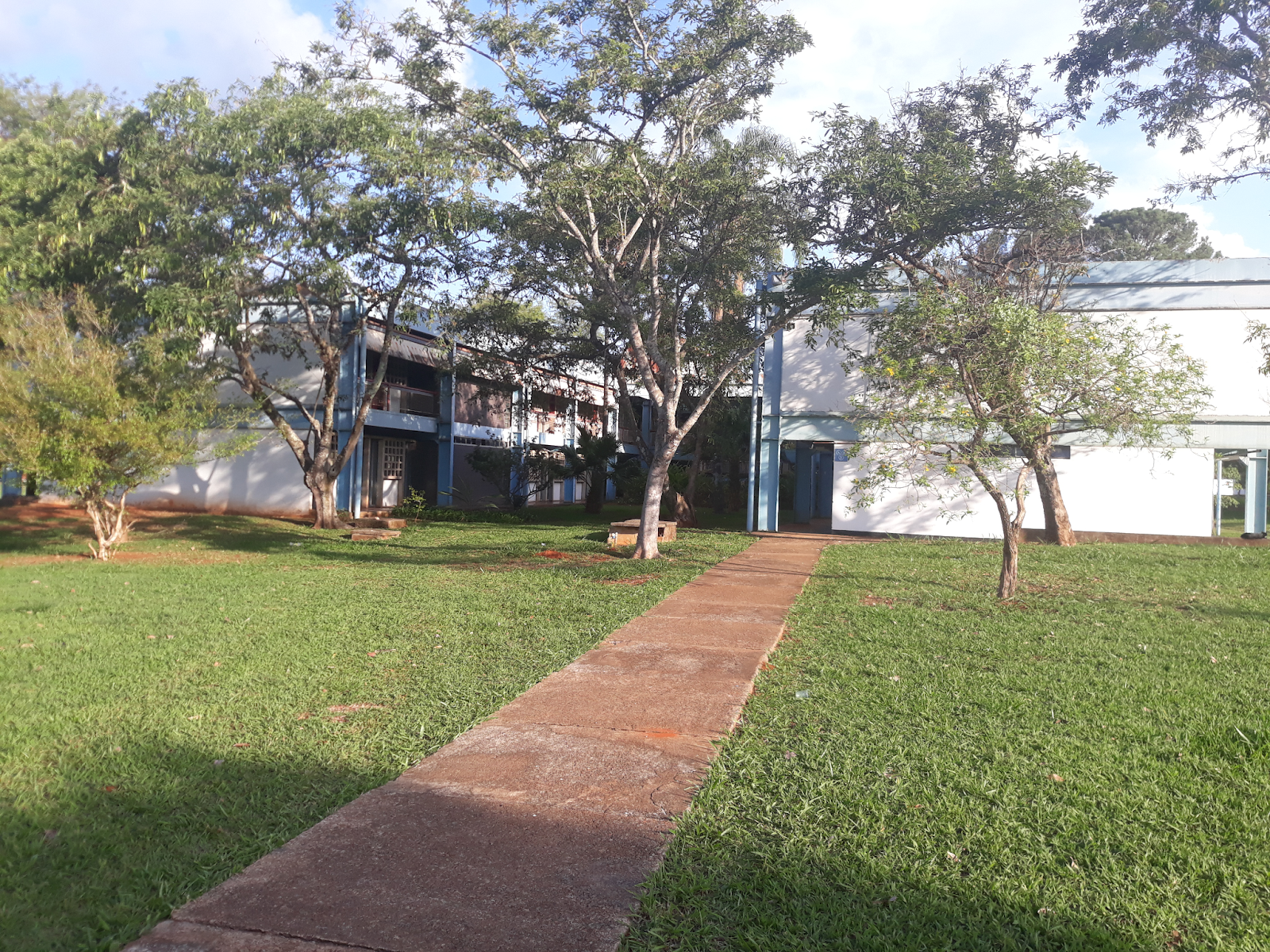
The event will be held in the Auditorium of the International Center of Physics (CIF), located on the Darcy Ribeiro Campus of the University of Brasília, as shown in the images below.


Organizing Committee
- Aleksandr Pinzul (UnB)
- Alexandre Dodonov (UnB)
- Arsen Melikyan (UnB)
- Carolina Matté Gregory (UnB)
Responsible for the support by Sociedade Brasileira de Física (SBF): Demétrio Antônio Da Silva Filho (UnB) - secretary of SBF at Distrito Federal.
Applications
The applications are open until August 24, 2025, via the registration form at the website:
Registration types:
- Attendee without presentation;
- Poster presentation (subject to approval by the organizers);
- Oral presentation (4 slots available, subject to approval by the organizers). If the oral presentation is not approved, the Organizing Committee may automatically recommend a poster presentation under the same title. The decision will be communicated by email.
Due to the limited number of positions, early application is strongly encouraged.
Financial support
- The organizers will provide lodging at the UnB transit apartment (free of charge for up to 6 nights) for selected participants from outside DF. Priority will be given first to participants with oral presentations, followed by those presenting posters. For more information about the transit apartments, visit: https://imoveisunb.unb.br/index.php?option=com_content&view=article&id=17&Itemid=787
- A limited financial support will be offered to selected participants from outside DF. Priority will be given first to participants with oral presentations, followed by those presenting posters.
- The financial support and the number of transit apartments is limited, so please apply early!
Accepted participants (without presentation)
- Gustavo Pinto da Silva Linhares Bezerra (IF-UnB)
- Luan Victor Barbosa dos Santos (IF-UnB)
- Amanda Vitória Miranda da Silva (IFG-Goiânia)
- Luigi Laurenti Berber (IF-UnB)
- Kazue Amorim Nishi (IF-UnB)
- Rodrigo de Menezes Barbosa
- Aline Lima Rosa (IF-UnB)
- Letícia Maria Rodrigues Wingler (IF-UnB)
- Alex Côrtes Derc (IF-UnB)
- Amanda Barboza Gaudart (IF-UnB)
- Yago da Costa de Almeida (IF-UnB)
- Luiz Fernando Ribeiro Martins (IF-UnB)
- Carmen Mamani Soncco (IF-UnB)
- Luzimagno Goes dos Santos Junior (IF-UFBA)
- Renan Pereira Nunes Almeida (IF-UFBA)
- João Victor Caires Santos (IF-UnB)
- Hugo Diniz de Souza Filho (IF-UnB)
- Anelisa Granato de Sousa (IQ-UnB)
- Alice Bessa Dias (IF-UnB)
- Leslaw Adam Rachwal (IF-UnB)
- Artur Borges Coleta Nascimento (IF-UnB)
- Disrael Camargo Neves da Cunha (IF-UnB)
- David Barbosa de Souza Neto (IF-UnB)
- Adriano de Medeiros da Silva (IF-UnB)
- Leonardo Martins Monteiro (IF-UnB)
- Pedro Moreira Machado de Souza (ICE-UFJF)
- Daniel Alberto Magalhães de Almeida (IF-UnB)
- Maike de Sousa Silva (IF-UnB)
- Sidnei Guerino Fabris Junior (DF-UFPR)
- Danielle Parente da Costa (IF-UnB)
- Marcos Vinicius Silva de Paula (IF-UnB)
- Clara Porto Scartezini (IF-UnB)
- André Luis de Oliveira Batista (IF-UnB)
- Vitor Rocha Menezes (IF-UnB)
- Hebert Souza Rêgo de Oliveira (IF-UnB)
- Eduarda Lima de Oliveira (IF - UnB)
- Kauê Rafalovik Bezerra (DM-UnB)
- Gabriel dos Santos Bomfim (IF-UnB)
- Sávio de Melo Rocha (IF-UnB)
- Vitória Alves de Souza (IF-UnB)
- Daniel Lima de Sousa (IF-UnB)
Accepted poster presentations
- Cleber Brito Figueiredo (IF-UFBA): Duffin-Kemmer-Petiau representations in $d < 7$
- Júlio Tito Magalhães Mendes (DF-UFC): Variational Mechanics of Homogeneous Isotropic Cosmology
- Erick Damasceno Moreira (DF-UFC): Electromagnetic Wave Propagation and Geodesic Deviation in Curved Spacetimes
- Gislany Queiroz Sales (DF-UFC): Reflection and Transmission Across Quantum Regimes: From Schrödinger to Klein-Gordon and Dirac
- Lucca Rodrigues Cunha (IF-UnB): Quantum Random Numbers Generation: A Photonics and Electronics Overview
- Gustavo Barreto de Oliveira (DF-UEL): Density matrix formalism for decoherence: explaining the CMB power spectrum from inflationary quantum fluctuations
- Marco Antônio Damasceno Faustino (IF-UnB): Entanglement entropy in Rabi Model on 3-Photon Resonance
- Gabriela de Matos Feu (IF-UnB): Equações de Friedmann - uma introdução ao modelo padrão da cosmologia
- Rodrigo Mendes Ribeiro (IF-USP): Algebraic Quantum Mechanics
- Vitória Machado Costa (IF-UnB): The Role Of Roughness in Exciton Dissociations in a Trilayer Device
- Henrique de Rezende schelb (IF-UnB): Metrological power of single qbit dinamical casimir effect in circuit qed
Accepted oral presentations
- Gabriel Capelini Magalhães (DF-UEL): General aspects of higher-form symmetries and applications
- Alexandre Pereira da Costa (IF-UnB): One- and multiphoton resonances in the light-atom interaction
- Luiz Felipe Demétrio (DF-UEL): Predictions of a Two Fluid Quantum Cosmological Model
- Giulia Aleixo Santana do Nascimento (IF-UnB): Lightcone fluctuations and an estimation to the size of the extra dimension in a five-dimensional Kaluza-Klein model
History
The School of Physics Roberto A. Salmeron (EFRAS) is a national-level school dedicated to the complementary training of undergraduate and graduate students, which in each edition seeks to enhance its internationalization. Its program includes mini-courses on current topics in Physics, lectures, panel discussions, and presentations of submitted works in the form of oral presentations and posters, providing an appropriate environment for student training as well as interaction with Brazilian and international professors and students. The school is promoted by the International Center of Physics and the Institute of Physics at UnB and has been held continuously since 2012.
The name EFRAS is a tribute to one of the founding professors of the Institute of Physics at the University of Brasília (IF-UnB) - Prof. Roberto A. Salmeron (São Paulo, June 16, 1922 – Paris, June 17, 2020), who was a prominent physicist in the field of elementary particles, having worked not only at IF-UnB but also at CNRS (France), where he retired.
EFRAS has been held annually since 2012 and usually focuses on a major theme at each event, as described below:
- Mecânica Quântica - fundamentos e aplicações (2012)
- Interações Fundamentais (2013)
- Fenômenos críticos e Transições de Fase (2014)
- Novas fronteiras em Ciência dos Materiais (2015)
- Avanços na interação radiação-matéria: Temperatura, dissipação e emaranhamento (2016)
- Ensino de Física (2017)
- New Trends in Quantum Field Theory (2018)
- Aprendizagem de Máquina na Física e Ciências Exatas (2019)
- Quantum Mechanics: foundations and new trends (2020)
- Gravity: new trends and perspectives (2021)
- Física e seu Ensino (2022)
- Jornada Científica e Acadêmica da Física, em comemoração aos 50 anos de graduação em Física na UnB (2023)
- Mãos na massa em Tecnologias Quânticas e Inteligência Artificial (2024)
- Modern Topics in Mathematical Physics
Contact
- Aleksandr Pinzul: apinzul (at) unb.br
- Alexandre Dodonov: adodonov (at) unb.br
- Arsen Melikyan: amelik (at) unb.br
- Carolina Gregory: carolina.gregory (at) unb.br
